Before care comes listening: FLA OHT and Indigenous palliative care
April 15, 2026.
Imagine facing the end of life, yours or someone you love, and the care offered doesn't speak your language, doesn't honour your traditions, and has no idea what a good death means to you. This may sound like an isolated problem, but it is not. For many Indigenous peoples across Canada, this is an everyday reality.
In October 2025, a gathering in Tyendinaga sought to change that.
A collaborative, community-engaged effort involving members of the Indigenous-focused subgroup of the palliative care working group of the Frontenac, Lennox & Addington Ontario Health Team (FLA OHT), researchers from Queen’s University, and Indigenous community partners brought together over a dozen community members, patients, caregivers, and knowledge holders, for a Talking Circle focused on palliative and end-of-life care.
The goal was simple: to listen. Before designing any solutions, the FLA OHT palliative care working group’s Indigenous-focused subgroup made a deliberate choice to sit down with the community first and learn. Funded by a grant from the Canadian Institutes of Health Research (CIHR), the gathering was the first of multiple planned to explore experiences and specific needs of Indigenous individuals, their families, and their communities at the end of life. More information about the at Talking Circle project can be found here.
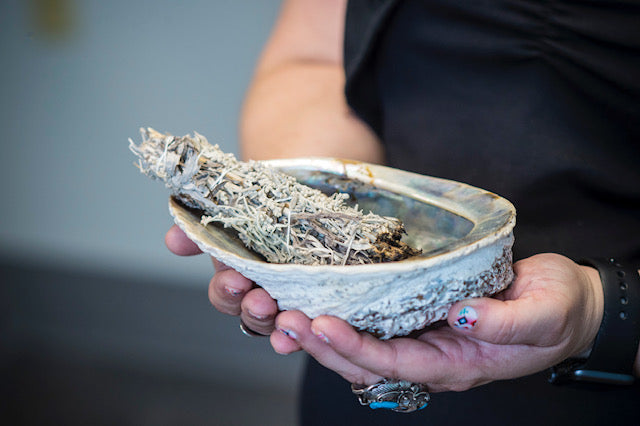
The session began with a shared meal, creating an opportunity for participants to gather informally before the Talking Circle formally opened. Community member Lynn Brant opened the Circle with smudging and facilitated the Circle. Catherine Galbraith from the Mohawks of the Bay of Quinte Home & Community Care was also present and supported the ceremony, serving as a cultural and emotional support person should anyone require additional support during the Circle.
As the conversation unfolded, each person was given punched leather and strings to craft their own grief medicine bag. It was a quiet act, but a grounding one as it set the tone for everything that followed. For Sophy Chan-Nguyen, one of the members of the team who helped organize the day, none of this was incidental. "The grief medicine bag activity was suggested and facilitated by community members on the team, and it was something that could not have been envisioned without their leadership. It is actually an essential part of the Talking Circle. To me, in watching each participant work on their bag, it appeared that individuals were able to sit with and process very difficult experiences in the company of others who were going through a similar journey."
Over two and a half hours, participants spoke openly about what meaningful palliative care looks like from where they stand. What emerged was a picture that looks very different from the one typically offered by Western medicine. As an example, in many Indigenous communities, death is not a medical event to be managed. It is a deeply relational and spiritual passage that belongs to the whole circle of care, not just the patient in the bed. Participants spoke of wanting traditional medicines to be present in the room. They spoke of wishing to pass at home, surrounded by family and community. They also expressed the need for their worldview, not just their symptoms, to be respected.
The Talking Circle opened a door that no one wanted to close afterwards. What started as a one-time gathering turned into something bigger: Following the Talking Circle, Catherine Galbraith, who served as the cultural support person, connected with participants interested in continuing the conversation. Individuals have continued to meet - not because anyone asked them to, but because the conversation was worth continuing.
The FLA OHT recognizes that this is the work that must come before the work. This collaborative project with academic and community partners seeks to build a foundation of understanding on a path toward concrete actions to support palliative and end of life care for Indigenous individuals and communities in the FLA OHT region.
The Talking Circle was one afternoon. The path it is helping to build is much longer, and it is one the FLA OHT is committed to walking together.
The FLA OHT and the project team are grateful to all who shared their time, their stories, and their trust. In keeping with the spirit of the Circle, individual participants are not identified in this article.
________________________
Photo credit: Matthew Manor (used with permission)